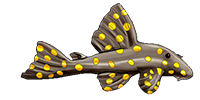


Cory = helmet, doras = skin. In this case it was incorrectly used to mean armour (cuirasse) instead of skin in allusion to the dual rows of plates that run along the flanks of this genus. From the Latin Tres meaning three and lineatus meaning 'of a line'. Alludes to the two pale and single black line running along the fishes body.
Corydoras are identified by their twin rows of armour plates along the flanks and by having fewer than 10 dorsal fin rays. They are most commonly confused with the other genera in the sub-family, namely Brochis, Scleromystax and Aspidoras. Probably the most misidentified fish commonly found in aquatic retailers who incorrectly sell it as C. julii. The true C. julii is such a rare import that sheer numbers mean you are unlikely to really encounter this Brazilian fish. C. julii is similar to the more spotted forms of C. trilineatus but has no trace of any reticulated colour patterning at all and is entirely covered with small, distinct spots. It's mid-lateral black stripe is fainter and does not reach as far towards the fishes head as in C. trilineatus
Peruvian amazon: Rio Ampiyacu, Rio Ucayali and the Yarina Cocha. Ecuador: Rio Pastaza. Amazon, Upper Amazon, Marañón, Ucayali(click on these areas to find other species found there) Amazon, Upper Amazon, Ampiyacu(click on these areas to find other species found there) Amazon, Upper Amazon, Marañón, Pastaza(click on these areas to find other species found there)
Sandy or small rounded gravel is required to ensure the fishes barbels are not damaged in the search for food. Some plants should be used to provide shade and a sense of security.
Should be kept in a shoal of at least six individuals. This, along with the presence of some mid water shoaling species, will increase the confidence of the fish in a community tank environment.
The fish appears to prefer clean, soft water and should be conditioned in such an environment. pH and temperature seem less important but a drop in temperature may induce spawning. The eggs hatch after four to five days. The eggs are very susceptible to fungus and best removed, treated and the fry allow to hatch in a very controlled environment. The young can be raised on newly hatched brineshrimp again vigilance in respect of water quality is paramount.
- CotM 2001 April - Show thumbnails of all species of Corydoras -
Search Planet Catfish for more on Corydorastrilineatus - BBcode (for use in linking to this page from forum posts)
- Email a friend a direct link to this species page - Look up Corydorastrilineatus on Fishbase, I.T.I.S. or ispecies search. - Print friendly layout of data - URL (for use in linking to the species from anywhere on the web)
Has this page been useful? Please click on the paypal button to make a secure & direct donation to our monthly hosting costs - it makes a real difference to us and we'll record the good deed for posterity. Help keep us free for everyone to enjoy!