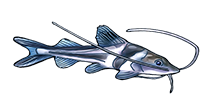



/siluriformes/callichthyidae/callichthys/callichthys/1.jpg "Callichthys callichthys")
Cascarudo/Armoured Catfish, Langstrakt Pansermalle (Denmark), Schwielenwels (Germany) - Callichthys callichthys (Linnaeus, 1758)
Article © Julian Dignall, uploaded October 29, 2023.
Since the dawn of keeping catfishes in aquaria, the best-known armoured catfishes have come from the family Callichthyidae. There are many, many species in the group and quite a few of these little swimming tanks are tricky to tell apart. Some, like this months' featured species stand out. To reuse the oldest taxonomical joke in the book, this one was so armoured, they named it twice.
Sometimes fish just seem to disappear from the hobby for one reason or another, only to suddenly become available again later. This has been the case with Callichthys callichthys which was quite popular in the past. It seemed that everyone was spawning them back in the 80's - and then you just couldn't seem to get them anymore. My first introduction to Callichthys was the Perth fishkeeping show in the late 1980s where maybe 1" (25mm) fishes were being sold for £1. I kept these fish for a few years, and they grew rapidly. While it seemed many were breeding these catfish at that time, after a couple of years, no one was breeding them anymore. Perhaps the challenge of breeding them had long disappeared. Perhaps breeders of these fishes get overrun by them. As like in the Sorcerer's Apprentice, the brooms keep multiplying to a point where chaos ensues.
Widespread throughout South America, all members of the family Callichthyidae have two overlapping rows of bony plates along their flanks. Others that are perhaps more familiar in the family include Hoplosternum, Megalechis, Dianema, Aspidoras and Corydoras (the most kept of the Armoured catfishes). Callichthys callichthys is also referred to as the Mailed Catfish.
Callichthys are easy to sex, the male having a thickened first ray to the pectoral fins. They can be easily distinguished by their cigar like shape, the characteristic flattened head, rounded caudal fin and small piercing eyes. Callichthys are amongst the largest members of the family and are boisterous, especially at feeding time, so I would recommend that they be kept with other similar sized fish, or groups of livelier smaller fishes. The catfish are shoaling in nature and are therefore best kept in groups. They are also able to take oxygen from the air at the water surface, which enables these fishes to survive in poorly oxygenated water, The main problem associated with poor water quality with these catfish is degeneration and loss of the barbels, this can be overcome with regular partial water changes.
Callichthys callichthys seemed destined to be a catfish from the past but they do enter the trade from time to time. Once or twice a decade they are sighted as odd specimens at one or two retailers. Sometimes this results in an advanced aquarist working with them and then young fishes become available on the auction circuit or the better shops.
But it seems destined not to be a species that is commercially bred. So, we all need to play a part in fish conservation by keeping groups of these fishes or breeding them. Callichthys are bubble nest breeders. Prior to breeding them, they can be brought into breeding condition by feeding protein rich foods such as freshly chopped earthworms and live or frozen bloodworm. As medium sized fishes, that will eat well and so need a decent volume of water and to flourish, a 36" x 12" x 15" (90x30x45cm) aquarium in which to spawn Callichthys. It does not need to be that high, but it's often easier to buy tanks that size. 12"/30cm tank height will work. The temperature should be around 78°F. The aquarium needs to be sparsely decorated but should include live aquatic plants. Vallisneria or Elodea works well, as the male Callichthys will cut off the plant with his pectoral fins to incorporate into the bubble nest When in breeding condition, the male's pectoral fin will be bright orange red in colour and both the male and female will develop an orange-red underside. In order to stimulate the pair to spawn, two water changes, say 25% minimum, should be carried out and cooler water added to the breeding tank. This triggers the breeding sequence.
In the wild, these fishes spawn in the rainy season. The influx of rain results in a drop in water temperature as well as an improvement in water quality. While that is thee trigger, it also benefits the fishes as wider areas are inundated and become available as spawning sites.
At this stage, add something that floats and remove the sponge filter. A plastic lid or piece of polystyrene will do, a water lily or broadleaf houseplant cutting will also work. Under any of these, the male will construct his nest - they are not fussy. The male constructs this nest incorporating pieces of aquatic plant and mucous bubbles. Male Callichthys have also been known to blow into their bubble nests. This behaviour is similar to that of anabantoids like Siamese fighting fish and the Dwarf Gourami. Once the nest is constructed, it may protrude above the water surface, It is at this stage that the male displays to the female and omits audible grunts to her. When ready to spawn, both the male and the female Callichthys will adopt an upside-down position in the bubbles, this may last up to two hours. The male places the fertilised eggs into the safety of the bubble nest. The eggs are quite large and can be seen in the bubble nest. Most spawning will consist of 100-150 eggs. The male then guards the nest until the fry hatch and become free-swimming. At this stage, it is a clever idea to carefully remove the female without damaging the bubble nest. If left, the male will drive her away which in the confines of a tank can be vociferous and may damage the nest. This is natural too as she takes no further part in the guarding of the eggs and fry. The eggs will hatch after four days. The first day of hatching the fry will hang in the nest and on the sixth day, the fry will become free-swimming.
When the fry become free swimming, the male should also be removed to prevent him from predating on the fry. You can actually add him back with the female and set them up again - it is not hard to produce a lot of fry! If you have the space to keep the sexes apart and afford them "time off," this is a clever idea too.
At this point, it is also a clever idea to drop the water level in the breeding tank because the young fry will eventually come to the water surface to take gulps of air. Breeders report that it is critical that the temperature of the air above the water is the same as that of the aquarium water to prevent the fry from dying after breathing cool air. During the first week after hatching, the fry should be fed on small lives foods such as newly hatched brine shrimp, microworms and cyclops, taking care not to overfeed. As the fry quickly grow larger foods can be introduced until the fry are eating prepared flake foods As the fry increase in size, the water level can be gradually, increased to 6"/15cm when a mature sponge filter can be added to the tank, this should take place over the first week. Ensure the new water is at the same temperature. When the filter is added, water changes of 25% should be conducted on a weekly basis or more frequently if contamination of the water has arisen due to overfeeding. The water level should continue to be gradually increased to normal as the fry grow. Assuming the fry survive, you will be left with quite a number of healthy young fish which you should be able to sell or part-exchange at your local shop, or if you are a member of a fishkeeping society, you may be able to sell some at an auction or club meeting.
Copyright information for the images used in this article can be found on the species' full Cat-eLog page.
 Cat-eLog Data Sheet Cat-eLog Data Sheet | |
|---|---|
| Scientific Name | Callichthys callichthys (Linnaeus, 1758) |
| Common Names | Cascarudo/Armoured Catfish Langstrakt Pansermalle (Denmark), Schwielenwels (Germany) |
| Type Locality | American rivers. |
| Synonym(s) | Callichthys affinis, Callichthys arcifer, Callichthys asper, Callichthys caelatus, Callichthys callichthys bolteni, Callichthys callichthys demararae, Callichthys depressus, Callichthys hemifractus, Callichthys kneri, Callichthys laeviceps, Callichthys loricatus, Callichthys tamoata, Silurus callichthys |
| Pronunciation | kal ICK thiss |
| Etymology | Callichthys: From the Greek kallos, meaning beautiful and ichthys, meaning fish; in reference to the colour pattern. As per genus. |
| Articles |  - CotM - CotM  2023 October 2023 October |
| Species Information | |
| Size | 165mm or 6.5" SL. Find near, nearer or same sized spp. |
| Habitat Information | |
| Distribution | South America: Most Cis-Andean South American river drainages north of Buenos Aires, Argentina. Amazon (click on these areas to find other species found there) Guyana Waters, Coastal Rivers of Guyanas, Essequibo (click on these areas to find other species found there) Orinoco (click on these areas to find other species found there) La Plata, Paraná, Paraguay (click on these areas to find other species found there) Guyana Waters, Coastal Rivers of Guyanas, French Guyana Coastal Rivers, Oyapock (click on these areas to find other species found there) Log in to view data on a map. |
| IUCN Red List Category | Least Concern, range map and more is available on the IUCN species page. Last assessed 2020. |
| Temperature | 18.0-28.0°C or 64.4-82.4°F (Show species within this range) |
| Husbandry Information | |
| Feeding | Easy to feed, will eat most prepared, frozen and live foods. User data. |
| Furniture | Prefers a well shaded tank. Floating plants, and tall broad leaved plants make good shade. They also like overhanging stones, tunnels, etc. |
| Compatibility | A fairly large fish that can be boisterous when feeding, so as long as tankmates accept this behaviour. |
| Breeding Reports | There is no breeding report. |
| Further Information | |
| Reference | Systema Naturae, Ed. X v. 1, pp 307. |
| Registered Keepers | There are 25 registered keepers, view all "my cats" data. |
| Wishlists | Love this species? Click the heart to add it to your wish list. There are 6 wishes to keep this species, see who wants what. |
| Spotters | Spotted this species somewhere? Click the binoculars! There are 15 records of this fish being seen, view them all. |
| Forum BBCode | |
| Search for C. callichthys | |
 | Look up C. callichthys on AquaticRepublic.com |
 | Look up C. callichthys on Fishbase |
 | Look up C. callichthys on Encyclopedia of Life |
 | Look up C. callichthys on Global Biodiversity Information Facility |
 | LFS label creator |
| Last Update | 2023 Nov 11 01:51 (species record created: 2023 Oct 29 07:54) |
Back to Catfish of the Month index.