


Article © Wolfgang Ros, uploaded January 01, 2002.
Preface
This article, entitled as "Erfolgreiche Froschwels-Nachzucht im Aquarium", was first published in July 2004 in the German magazine "Die Aquarien- und Terrarienzeitschrift" (DATZ) 7/04, pages 12-15; The article was translated into English and published on planetcatfish.com by kind permission of Mr. Rainer Stawikowski, editor-in-chief of DATZ. All text enclosed in square parentheses denotes additional data from the author. Where possible, photos have also been updated and new ones added.
Introduction
My acquaintance with Clarias batrachus goes back a long way. For many years as a child I took care of a specimen of the wild form; an individual that reached about 35 cm in length housed in a "large” (by 70's standards) 240-litre aquarium. Although this fish was not cosmetically beautiful, I was, nevertheless, fascinated by its tenacity, its ability to cope, and, above all, its insane greed.
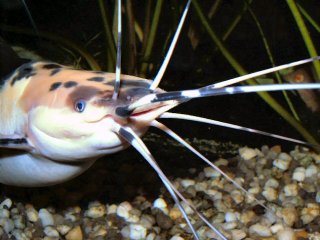 Portrait of my Clarias batrachus male (piebald)
After nearly 30 years, during which I have predominantly taken care of South American Cichlids and Catfish (especially Sorubim lima), I decided to populate my newly set-up 700 lit re living room aquarium with three C. batrachus. I hoped of course, that a pair would be among these. A main driving factor in this decision was an article regarding Clarias angolensis, written by Reinhold Wawrzynski, which had recently been published on the Internet. This report was hugely important to me because reading it vividly brought back memories of my earlier Clarias care. As an aside, I later got to know Reinhold Wawrzynski and I owe him my thanks for many valuable insights into the care and breeding of Clarias.
The first of the three Clarias - a female as it turned out later - I bought at the beginning of January 2003 in a local shop for ornamental fish. She cost 5 Euros and was approximately 10cm long, a white individual with black marks and lacking the red eyes found in albinos. Unfortunately only this one was available, so I ordered a further two. These two duly arrived one week later, a white one, again with black patches, and a pure Albino, both 10cm long. The colouring of both this black-and-white piebald variety and, in particular, the ghostly albino is, in comparison to the wild colour form, much more striking.
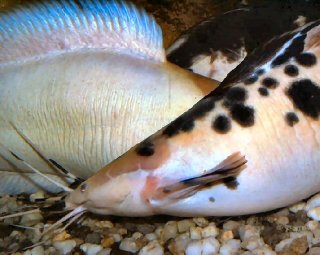 Male at its favourite place in front of a cave
Sexing
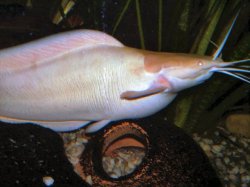
Determining the sex of C. batrachus is not quite as simple as the literature would have you believe. The description that adult males have "thickened pectoral fin rays" is less than helpful because the aquarist usually has to select from younger specimens. Also the rule that the dorsal fin of the male shows spots contrary to that of the female is unreliable for the piebald variety and obviously cannot apply at all to pure Albinos. However the distinction can be made even with pure albinos from around the 15cm mark, because the body of the female is already noticeably bulkier and seems to be fuller in the comparison to the clearly slimmer male.
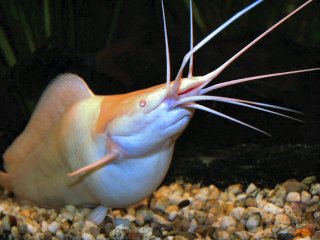 Gravid albino female
[In particular the girth of the female is thicker than that of the male even after spawning has completed. Also the female looks altogether more imposing – a feature that becomes especially relevant at breeding time. Cichlids, for example, that inadvertently find they are confronted by a maternal female escape at first sight; no such wide berth is given to the male. Furthermore there are also differences in the behaviour and the swimming movements of the male and female. Realistically, this can only be learned by the experience observing a pair in the aquarium over time. However there is still another foolproof method of determining gender. It can also be utilised by any aquarist keeping at least medium sized Clarias. From C. gariepinus (the "big brother" of C. batrachus) we already know that the genital papilla of the male is elongated and pointed at the end, with the female however thick set, short and blunt. This distinguishing feature also applies to C. batrachus.]
 |
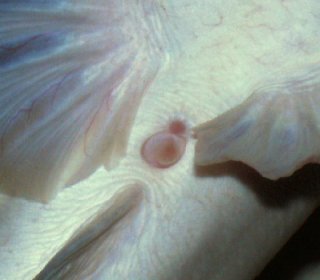 |
| Close-up of male genital area. | Close-up of female genital area. |
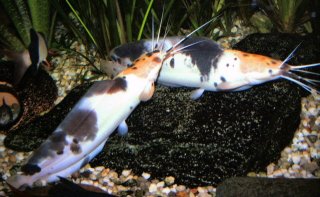 Male (foreground) and subdominant female
Weeks before this event the two females (Piebald and Albino) were already vying for the male's attentions, yet the male still behaved largely indifferent to them. But from then on, the constant competition between the two females revealed a "dominant female" - the albino was a certain winner. It became obvious and even the male then decided on his female. I observed, at least at during the spawning season, that an obvious of pair connection exists between these animals. This is a more subtle version of the intense bond that you can observe in numerous cichlids. The catfish usually swim side by side through the aquarium and also lie near one another when resting; only when feeding do they seem to revert to type; giving consideration to nothing else.
"Walking Catfish"
Once established, this "pair connection" meant that the other two fish jointly and persistently harassed the second female, to the extent that I had to remove it. Fortunately, an ornamental fish keeping neighbourhood friend had already expressed interest. The fish was duly transferred to a bucket and as my friend was about to take it away, the waiting fish suddenly made a bid for freedom and landed on the living room carpet. It immediately began to move across the room with the help of its pectoral fin rays, making noises as it did so. We caught it just in time, before it could disappear under some furniture. Fortunately, the fish was unhurt. In these moments it became crucially apparent to us why C. batrachus is called the "Froschwels" ("Frog Catfish") or "Wanderwels" ("Walking Catfish") in German. As is well documented, it is due to this ability that the fish was also able to escape from ponds in south Florida where it was bred commercially as a food fish, and has become, since around 1970, "domestic".
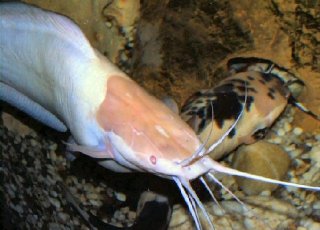 The pair above the spawning embrace site
Spawning
My Clarias pair spawned four times within the period of only five months: first in November 2003, then in the middle of January 2004 and finally to the middle of March 2004 and, in only the span of four weeks an incredible three further times. In November 2003 they preferred the gravel of a cave, which is set up at the rear aquarium wall and whose second opening is about 20 cm underneath the water surface. This behaviour could substantiate the thesis that in the wild, the animals lay eggs in caves found in the embankment a little underneath the water surface. When my female finally could not fit into the cave mouths due to her thick body, the open substrate in front of it was deemed good enough.
The reproduction event is preceded for two or three days by the fish repetitively swimming together even more frequently than before. Their wriggling motions focus above the center of the spawning site where they also begin initial excavation activities. despite their rapid movement. [The courting of the animals before spawning can be described as follows:
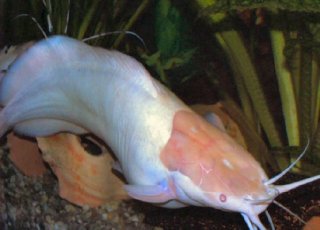 |
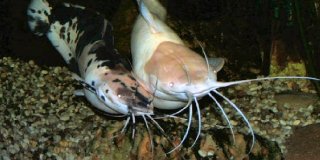 |
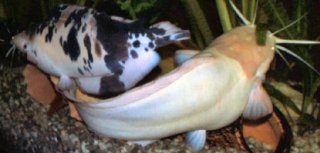 |
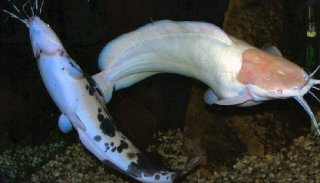 |
| First the female starts swimming, closely followed by the male. Above you can't recognize much from the male in the background except the barbels. | Again and again they make body contact. The female begins to move her caudal back and forth fast so to lure the male to follow it further. Particularly the male gently nudges with it's head the genital region of the female. | Then they move apart again... | ... until circling movements bring them together once more.] Full size pictures can be seen here. |
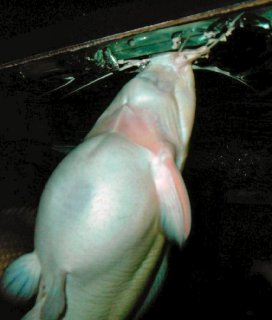 The gravid female gets air at the water surface
This accommodating species makes no special demands on water parameters. Due to its additional air respiratory organ the oxygen content in the water matters little. In most parts of the world you can also maintain Clarias batrachus in an unheated aquarium, - however the water temperature for breeding purposes should be about 25° C, no higher, otherwise the percentage of eggs that are stricken by fungus can increase considerably. In my tank there are no foreground plants, only some larger stones lying on gravel. It is plentifully furnished with plants along the rear. Using their heads and waggling themselves in parallel, both partners work together to dig a hollow in the clear gravel, until the widening pit has a diameter of approximately 30 cm. The pair takes, sometimes brief, sometimes longer breaks, from the toil. Even larger stones are shifted to the edge of this hollow in displays of sheer strength, with males and females participating to the same degree in this activity.
 |
 |
 |
 |
|
Both prosepctive parents work at creating a shallow pit nest - full size pictures can be seen here.
|
|||
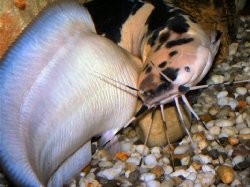
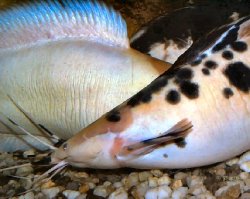
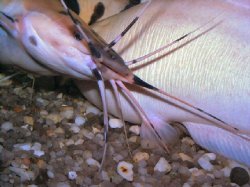
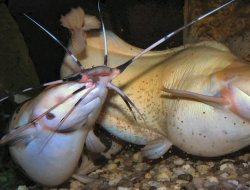
On the day of reproduction - a water change of a third in the morning seems to accelerate this - courting reaches a turbulent level. The animals mate over many hours; thirty, maybe forty times, initially without any eggs delivered. Altogether reproduction can drag on over 20 hours. In mating, the female pushes her head against the center of the male's body, actually pressing her partner into a u-shape. Both remain in this position for around 10 seconds in each instance until the female separates from looping, leaves the site and only returns again after some time. The animals often swim back and forth over the hollow pit, pressing themselves to one another before another mating. The female then makes her quiescent retreat to another area of the aquarium again, before, finally, swimming back to the male.
 |
 |
 |
 |
 |
|
The looping entanglements of the spawning embraces - full size pictures can be seen here.
|
||||
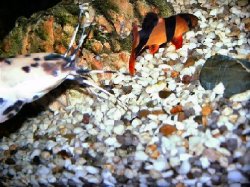
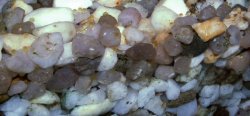
Throughout this time the pair do not tolerate any other fish in proximity to the nest. It is worth noting that species of Botia (such as Botia macracanthus or B. lohachata) that are presumed to be the first to raid the nest and eat the eggs are, in this phase of reproduction, particularly violently pursued (however without hurting these seriously), yet larger cichlids are only gently pushed away. All inhabitants of the aquarium quickly learn to avoid the nest, for their own safety. As soon as eggs are delivered from the mating, they drop to the substrate and remain stuck there. Several hundred to a thousand eggs are laid and one must expect even higher numbers from fully-grown pairs.
 |
 |
 |
 |
| Other fish are persued but not attacked. |
These three images depict the marathon spawning sequence.Full size pictures can be seen here.
|
||
 |
 |
 |
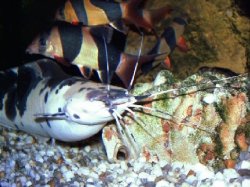 |
| Some of the large number of eggs at the bottom of the shallow pit. | Female's belly extent shortly before spawning. | Female's belly extent is noticeably smaller afterwards. | Male guarding the fry (hidden in gravel) from several Botia macracanthus. |
After the female has laid all her eggs, she seems to avoid the nest. She was found to prefer to rest under a large root; but her aggressive behaviour, in particular in relation to the Botia, still remained for some days. So, the female secures the outer perimeter of the nest and, subsequent to the final spawning activity, the male takes sole responsibility of directly guarding the nest. Frenetic, but untiring, he swims in circles over the spawning site. Even when fed as normal, he only drops his guard briefly to rapidly devour some food (less than usual) and immediately returns to his duty. [The male circles hectically over the hollow until fry hatch, most likely in an attempt to protect the eggs from dangerous intruders from all sides. The water movements resulting from the males exertions are surely of additional use in terms of development of the eggs. After hatching begins, the male rests over the spawning embrace site, from where he periodically checks the hatching progress by nuzzling and rolling over those stones in the substrate that have eggs attached.]
Feeding
Clarias are not difficult to feed; they take any live food such as Tubifex or earthworms, but just as readily eat frozen food such as red mosquito larvae. Additionally they will eat tablets, food sticks and even specialized food used for feeding farmed trout. Live worms that survive long enough to bury themselves in the gravel are found with unerring precision with the help of the catfish's barbels, excavated swiftly and eaten greedily. If the belly is extended to two or three times larger than normal then the fish has eaten its fill, and requires no more food, even on the following day. Young animals up to a size of approximately 15 cm seem to be most greedy. These can each take enormous quantities of food several times each day. This voraciousness seems to wane later in life; in any case full feeding of my fish every two days is sufficient.
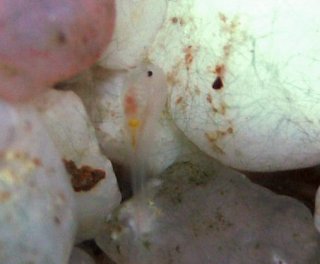 Fry hide themselves well in the cavities of the gravel
Raising
At 25° C the embryos hatch after approximately 30 hours. [As soon as the fry begin to emerge, the female approaches the male again. They meet briefly at the edge of the hollow, with accompanying violent body movements.] In this phase, defence of the nest once more becomes heightened in both partners, with division of responsibilities as before; while the male attacks other fish only if they come too close to the spawning site, the female secures the outlying areas. However, her ‘patrol' extends beyond the spawning site and extends to all fish in the lower water region of a 2-meter (6 foot) aquarium. [The female's behaviour changes now, for the next two to three days: while previously only Botia species were persecuted, all fish - except plant and algae eating species like Chinese algae eaters (Gyrinocheilus aymonieri) - must now withdraw to the upper water region. The female beats even fully-grown cichlids into retreat.]
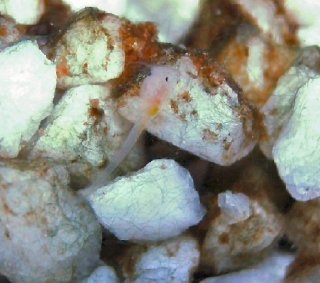 The barbels of the fry are already recognizable
After a further two days both partners' defensive vigour weakens. The female barely acknowledges the presence of other fish and similarly, the male no longer remains exclusively with the fry. Rather he increasingly roams the entire tank, until finally completely relinquishing guard of the nest. Now the Botia species seize their chance. As soon as the male departs, they are immediately upon the nest. They try to seek out and eat the tiny young fish, which are clearly smaller than newborn Guppies (Poecilia reticulata [less than 2 millimeters]) and can therefore hide themselves well in the cavities of the gravel.
After a further three days, the fry, now with barbels visible to the naked eye, swim freely. Realistically, however, they have a poor chance of survival in a community aquarium. Even the parents themselves may pursue the new generation. In these circumstances it is an absolute necessity to raise the fry in a separate tank or basin [start feeding them with Artemia naupli]. Better still, I would suggest removing the eggs even before they hatch. In the first life months the young fish grow fastest. [If you feed heavily and keep them in a sufficiently large tank, young fish will attain 30 cm or more after about only a year. Yet, from this size, C. batrachus grows comparatively slowly.]
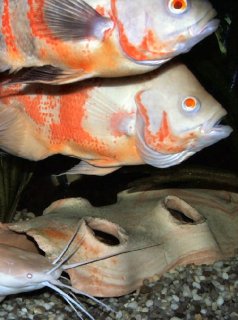
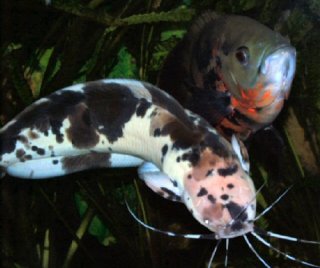 Male Clarias with male Oscar
Perception and Reality
In my opinion, the somewhat negative image associated with this species isn't always fair. For those catfish enthusiasts who have a sufficiently large aquarium (for instance starting at 300 litres upward for an individual animal, with two walking catfish accordingly higher) this species is comparatively affordable and due to its hardiness also suitable for beginners. Unlike many other catfish and after reaching a certain body length, this catfish is by no means light shy or reclusive, but also adapts rapidly to add daytime activity to its nocturnal prowlings. [So the behaviour of the walking catfish clearly differs from that of most other predatory catfish, which mostly remain in one place, watching for prey and moving only if necessary after lights off. Keep onlyClarias batrachus and you will have no catfish that hide themselves all day long behind a large root or a stone, but lively, omnipresent character fish. Keeping them never becomes boring]. Additionally, in contrast to many predatory Asian or South American catfish, Clarias do not have to be given exclusively live food. Even housing them in a planted aquarium is possible if only durable, firmly rooted plants are deployed.
 Three albinos!
If the tank is large enough and if there are sufficient refuges and retreats, this fish is not too aggressive towards co-inhabitants. Obviously the exception is the spawning season, but this caveat applies to many species. Socialization with Red Tail Black Sharks (Epalzeorhynchus bicolour) and Silver Sharks (Balantiocheilus melanopterus) as well as smaller fish like Botia [for example B. modesta, B. macracanthus or B. lohachata] or catfish (even the small Corydoras) is straightforward. Cohabitation with large, calm South American cichlids (for example Oscars (Astronotus ocellatus)) may also be unproblematic in the long term.
[The smaller species mentioned above are only feasible as cohabitants with Clarias batrachus if the comparative size relationships are appropriate. Nearly full-grown animals should be considered if you want to keep them with Clarias batrachus up to 15 or 20cm length. In addition the loaches must be given plenty of Botia-sized hiding places, because, as Clarias pursue them now and again, opportunities for avoidance are important. I've read several times on the Internet, that one can associate Clarias with large Plecos "no problem”. In my mind, some caution is required. Common plecos – certainly if at least half grown - can be very dominant and are capable of inflicting injury on scaleless catfish with the sharp leading ray of their pectoral fins. Certainly it is risky to generalise about socialisation. In any case it is important to avoid selecting aggressive fish to keep with Clarias, to pay attention to the size of these species relative to the Clarias and to provide a sufficiently large tank. If the latter is missing, one should avoid co-inhabitants (otherwise Clarias batrachus really will live up to its bad reputation). Ultimately the acquisition of this species should be avoided if adequate tank space is not available.]
 Keeping Clarias with larger community fish is straightforward
I did not observe the (often alleged) eating of adolescent fish; neither in the wild form kept in my youth, nor in the current (nearly 40 cm long) individuals. Admittedly walking catfish at this size have not yet attained full growth. [Yet, both fish seem to remain at this size in my tank, over the past months I have not observed more growth.]
The maximum size in the aquarium is purportedly up to 50 cm. However, one of the largest walking catfish measured in Florida was said not to exceed 40 cm. It is clear that catfish of this size leave little chance of survival to small fish like most livebearers. Nevertheless the small muzzle of the Clarias (in comparison to many predatory catfish) is unable to swallow up large portions, so the danger to species with high backs / dorsal fin appears small. As soon as they have accustomed themselves to a specific food, it seems that these animals - with exception to its favourite food of worms - will only indignantly and after some days of avoidance, eat other food. At present my fishes diet mostly consists of sticks for large cichlids, which they eat greedily from the water surface.
 Feeding at night on cichlid sticks
No one keeping them with other large fish should fear that these catfish could get too little when feeding. They soon know exactly when food is given. As soon as one approaches the aquarium, they anticipate and hurriedly swim to the feeding place and strive to be first to the food. Despite this vigour, one should refrain from adding aggressive fish. Co-habitation with a nearly full grown male Red Devil Cichlid (Amphilophus citrinellus) was successful only for a time. When this cichlid began to demand a certain range of the aquarium for itself and attack the walking catfish, they were only briefly cowed before turning as one to a concerted counter attack. These fights dragged on over days until I took the cichlid out of the tank.

Author
Wolfgang Ros, 40, inherited the aquatic hobby from his father. He is particularly interested in catfish and cichlids and also maintains that currently unpopular species can have their attractions.
This article was first published in the German publication: Die Aquarien und Terrarienzeitschrift (Datz). Our thanks apply here for the Datz editorship and their editor-in-chief, Rainer Stawikowski, who gave us kind permission to publish this article on PlanetCatfish. © Copyright text and photos, Datz.
There is further information on this species on the Cat-eLog page.
Back to Shane's World index.