

3
2
1
Home Please visit Amazonas Magazine proud sponsors of PlanetCatfish.com
  |  Home  | |  CotM  | |  Cat-eLog  | |  Shane's World  | |  Forum  | |  Books  | |  Cool  | |  Search  | |  Help!  |
Quick find:
Convert Length, Temperature or Volume

Jump to next sectionCat-eLog > Chacidae > Chaca

Jump to next section Cat-eLog Data Sheet
Scientific Name Chaca chaca  (Hamilton, 1822)     
Common Name(s) Frogmouth Catfish
Type Locality Ne. Bengal.
Synonym(s) Chaca buchanani, Chaca lophioides, Chaca lophioides, Platystacus chaca
Pronunciation CHA kah - chack ah
Etymology Chaca: The name comes from the local name of the fish, which is probably derived from the sound it makes when irritated. 
Jump to next section Species Information
Size 180mm (7.1") SL. Find near, nearer or same sized spp.
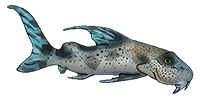
Identification C. chaca is a chocolate brown while the similar C. bankanensis is a brighter orange-brown.
Sexing Males are larger and longer while females are shorter and more bulky.
Jump to next section Habitat Information
Distribution Ganges / Brahmaputra drainage basin of India and Bangladesh.
Indian waters, Padma, Ganges (hover or click on these areas to show maps or find other species found there)
Indian waters, Padma, Jamuna, Brahmaputra (hover or click on these areas to show maps or find other species found there)
pH 6.0 - 8.0
Temperature 22.0-24.0°C or 71.6-75.2°F (Show others within this range)
Other Parameters Curiously Chaca spp. appear to lower the pH of their aquariums, much faster than the usual pH drop of a neglected tank (often to lower than pH 6.0 with no apparent ill effects to the fish). Thus regular water changes and pH testing are required particularly in a smaller species tank. Buffering may be required in some instances. Some authors report the premature death of feeder fishes that do not tolerate lower - or quick shifts in - pH levels. There is an argument that Chaca species affect their prey chemically, but I feel this is unlikely and would cause more noticeable effect in the confines of an aquarium. What is interesting to note however is that Chaca spp. are considered poisonous by locals, particularly if stepped on. Maybe we are looking at a chemical mechanism developed by a very inactive fish to taste as bad a possible to predators. Another theory still is that this excess acidity is a side effect of the strong digestive juices required by a fish that eats its prey whole.
Jump to next section Husbandry Information
Feeding Baensch states that after acclimatization pellet food is accepted. I have observed hungry young C. bankanensis eating Tetra Prima (sold in the US as Tetra colorbits) soon after import. On the contrary, long time keepers of Chaca persistently try dried or even frozen food to no avail. Perhaps only young fish will learn to accept \'\'alternative\'\' foods. Either way, a Chaca keeper should be prepared to supply live fish on a regular basis.
Furniture A sandy substrate is suggested for all species of Chaca. Some leaf litter is appreciated by this fish although Java moss and plants that do not grow too tall are also effective. Hiding places are not required given subdued lighting.
Compatibility An irrepressible predator of small, especially bottom feeding fishes. Fast moving, surface dwelling fishes in tall tank (15''+) are unmolested. That said, anything that comes within range of a hungry Chaca's mouth will rarely survive. In my opinion, one for the species tank.
Suggested Tankmates See Compatibility.
Breeding This fish has been bred in captivity. A summary of the details follows:
Diet consisted of tubifex, shrimp, small fishes, earthworms and chopped beef heart. A group of 4 fish were kept in a 36 x 18 x 18 bare tank containing a 8'' x 3'' diameter pipe. Spawning occurs in the pipe with all other fish outside. A single (probably male) fish remained to guard the eggs, these hatched 3 days later. Parental care was not observed, yet neither was predation. 10 days after the eggs were laid the fry became free swimming. The next day they began feeding on newly hatched brineshrimp and sifted daphnia. Nearly 400 fry were raised to 1.5''. They developed steadily and uniformly among the brood.
Jump to next section Further Information
References Fishes Ganges - pp140, 374 - Pl. 28 (fig. 43)
Registered Keepers (1) CFC, (2) JAYcarreon, (3) Attu, (4) darkwolf29a, (5) Koltsix, (6) Dinyar, (7) kabaltah (k: 3), (8) The.Dark.One, (9) Shovelnose (k: 2), (10) dpk2313, (11) miles3, (12) headbanger_jib, (13) hockeydude9819, (14) arapaimag (k: 7), (15) hatiras.

Click on a username above to see all that persons registered catfish species. You can also view all "my cats" data for this species.

Add this species to your My Cats species list Add this species to your "my cats" page.
Breeding Reports None.
More Resources Article - CotM > 2001 > March
Article - Shane's World > Species > Feeding Chaca chaca
Search Planet Catfish - Search Planet Catfish for more on Chaca chaca
Link - BBcode (for use in linking to this page from forum posts)
Look up AquaticRepublic.com - Look up Chaca chaca on AquaticRepublic.com
Look up Fishbase - Look up Chaca chaca on Fishbase, I.T.I.S. or ispecies search.
Link - URL (for use in linking to the species from anywhere on the web)
Hits 27950 hits.
Last Update 2009 Mar 02 13:30 (species record created: 2001 Apr 20 00:00)

Who is online

Registered users: balken89, bigward, Bijn, Bing [Bot], Coryologist, Google [Bot], jay_leask


© 1996 - 2012 PlanetCatfish.com, part of the Aquatic Republic Network group of websites. All Rights Reserved. By accessing this site you agree to our Terms and Conditions of Use.