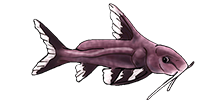


According to Vires, ''Dimorphism is difficult to notice unless the fish are at full breeding size. Probably the easiest way to sex these fishes is by the shape of their foreheads. Males have a flatter, more leveled slope to their foreheads and are slightly wider. Females have a more rounded forehead and are slightly plumper when in spawning condition. There is no noticeable difference in odontodal growth in either species.''
These fish are grazers, but not in the sense that they eat only vegetation. They actually sift and chew at the film of organic matter on hard surfaces in search of higher protein foods. In the wild this would constitute a variety of foods from small insect larvae and crustaceans to other animals eggs and possibly even recently dead animals. With this in mind, frozen foods such as bloodworm and blackworm should be offered along with frozen prawns. Algae and plants are avoided, but cucumber and courgette appear on the accepted menu. Accepted food morsel size changes with age in all of these fish.
Gold nuggets are territorial to other bottom dwellers and downright vicious to other gold nuggets. This stems from a desire to find and defend the best spawning cave, so take this into account if you plan to introduce these fish into a catfish tank. They do well in a community environment that fits their other requirements. Be careful with adult fish, they can kill each other in a crowded space.
Although strong currents are needed for breeding attempts, only good water quality and a high temperature are required for this fishes successful onward maintenance. Thus, characins are good biotope fish but you could look further afield at discus and gouramis. Most other cichlids tend to over compete for food with these fish, so be careful especially when introducing new gold nuggets.
Again I can do not better than quote Vires, ''After having spawned this species off and on for nearly 3 years, I had not found the requirement which would make it possible to easily duplicate the success until late last year. Each time, in the past, the fish would dig caves under the same piece of slate mounted driftwood and spawn in my Hypancistrus zebra grow-out tank. Whenever the pair was removed to another tank to attempt a spawning , nothing ever resulted from the effort. This is where my theory about the effects of current came in.
When setting up a new tank system, in an attempt to produce commercial numbers of several species, I intentionally oversize the pump to guarantee a good oxygen supply for all the fishes in the system. However, I had to find a place for my breeders while I made spray bars for the tanks and the fish were left overnight with only a direct flow from the water inlet. The next morning, upon inspection to see if everyone survived what I though would be stressful conditions, I found a cluster of eggs laid in the bottom of the tank in front of a rock. From that point on, convincing these fish to spawn has not been that difficult. Once a pair of fish is conditioned and have found a suitable spawning suite, the addition of a supplemental powerhead aimed at the cave is all that is required.
Raising the fry is not very difficult, but this is a long process. They will not reach beyond 2 inches within 6 months of age. Feedings should be given regularly with baby brineshrimp initially and the food size increase as the fry gain some size.''
Has this page been useful? Please click on the paypal button to make a secure & direct donation to our monthly hosting costs - it makes a real difference to us and we'll record the good deed for posterity. Help keep us free for everyone to enjoy!