

3
2
1
Home Please visit Swiss Tropicals proud sponsor of PlanetCatfish.com
  |  Home  | |  CotM  | |  Cat-eLog  | |  Shane's World  | |  Forum  | |  Books  | |  Cool  | |  Search  | |  Help!  |
Quick find:
Convert Length, Temperature or Volume

Jump to next sectionCat-eLog > Mochokidae > Synodontis

Jump to next section Cat-eLog Data Sheet
Scientific Name Synodontis njassae  Keilhack, 1908     
Common Name(s) Lake Malawi Syno
Type Locality Lake Malawi [Lake Nyasa], near Langenburg, Tanzania.
Pronunciation sin oh don tiss - ni ASS ay
Etymology Synodontis: From the Greek syn, meaning together, and odontos, meaning tooth; in reference to the closely-spaced lower jaw teeth. Named for the old name of the lake of origin, Nyassa, which is now called Lake Malawi.
Jump to next section Species Information
Size 190mm (7.5") SL. Find near, nearer or same sized spp.
Identification All species in the genus Synodontis have a hardened head cap that has attached a process (humeral process) which is situated behind the gill opening and pointed towards the posterior. The dorsal fin and pectoral fins have a hardened first ray which is serrated. Caudal fin is always forked. There is one pair of maxillary barbels, sometimes having membranes and occasionally branched. The two pairs of mandibular barbels are often branched and can have nodes attached. The cone-shaped teeth in the upper jaw are short. S-shaped and movable in the lower jaw. These fish produce audible sounds when disturbed rubbing the base of the pectoral spine against the pectoral girdle.

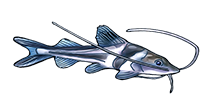
Apparently easy to identify in the field as it is the only species from the Lake. That said, a large and small spot variety exist. Otherwise the fish can be identified by it's long, slender body, pale barbles and dimly spotted leading fin rays. The larger spot variety is similar to S. ocellifer but the more elongate body is the best visual characteristic to use for identifying S. njassae.
Sexing First lay the fish in your hand with its head toward your palm and the tail toward your fingers. Hold the dorsal spine between your middle and ring finger so the fish is belly up and you won't get stuck (which by the way, hurts like crazy!) The genital pore is in a small furrow of tissue (in healthy fish) and will be obstructed by the pelvic fins. Pull down on the tail gently to arch the fishes spine and the pelvic fins will stand and the furrow open to display the genital pore and the anus of the fish. The male has a somewhat ridged genital papillae on which the spermatoduct is on the back side, facing the tail fin. A gravid female will also show an extended papillae but the oviduct is on the ventral side of the papillae (And may also show a little redness if really gravid). A thin or emaciated female will have just two pink pores, the oviduct and the anus.
Jump to next section Habitat Information
Distribution Africa: Lake Malawi
African Waters Show it on a map , Zambesi, Malawi Show it on a map  (hover or click on these areas to show maps or find other species found there)
pH 7.6 - 8.4
Temperature 23.0-28.0°C or 73.4-82.4°F (Show others within this range)
Other Parameters Although hardy, this fish is visibly happier in clean, well filtered water.
Jump to next section Husbandry Information
Feeding Vegetable extract foods and tablet foods. Will accept commercial foods.
Furniture Rocks piled along the back pane will provide cover.
Compatibility Not advised to mix with other Synodontis unless a large tank is provided.
Suggested Tankmates Generally peaceful towards both its own kind and mbuna, only keep with semi-aggressive fish.
Breeding Konings (pictured in his book is the small spot variety) reports that, in nature, this species is thought to spawn in the months of October to December when it can be found over sandy and muddy substrate. It can be found in traps laid in these areas indicating it still feeds during these months. Around this time large numbers can be collected in the Senga Bay (southern end of the lake) during the night. This activity suggests night time spawning therefore precluding it being a cuckoo spawner like some Tanganyikan congeners.

At other times of the year it spends the day in, and the night patrolling around, rock piles.
Jump to next section Further Information
References Sitzungsber. Ges. Naturf. Freunde Berlin1908 (no. 7) - pp168
Konings, Ad. Cichlids and all the other fishes of Lake Malawi. TFH, 1990.
Registered Keepers (1) Oliver D. (k: 6), (2) synodont_fan, (3) Tulio, (4) fishbok, (5) Dave Rinaldo, (6) d_frag, (7) Moomoo, (8) dragonphish, who also notes: "i finally got a malawian cat! ", (9) Azarak, (10) tasoulis (k: 2), (11) foley, (12) Richard B (k: 2), (13) oliv67 (k: 10), (14) Norbert (k: 4), (15) Wallace, (16) jippo, (17) Hellcatt, (18) maas.

Click on a username above to see all that persons registered catfish species. You can also view all "my cats" data for this species.

Add this species to your My Cats species list Add this species to your "my cats" page.
Breeding Reports None.
More Resources Search Planet Catfish - Search Planet Catfish for more on Synodontis njassae
Link - BBcode (for use in linking to this page from forum posts)
Look up AquaticRepublic.com - Look up Synodontis njassae on AquaticRepublic.com
Look up Fishbase - Look up Synodontis njassae on Fishbase, I.T.I.S. or ispecies search.
Link - URL (for use in linking to the species from anywhere on the web)
Hits 22382 hits.
Last Update 2009 Jan 01 14:13 (species record created: 2003 Aug 16 00:00)

Who is online

Registered users: Bing [Bot], Google [Bot]


© 1996 - 2012 PlanetCatfish.com, part of the Aquatic Republic Network group of websites. All Rights Reserved. By accessing this site you agree to our Terms and Conditions of Use.