



Cat-eLog Data Sheet | |
|---|---|
| Scientific Name | Corydoras haraldschultzi Knaack, 1962 |
| Common Name(s) | Schultz's Cory |
| Type Locality | Rio Guaporé, Brazil. |
| Pronunciation | Kory DOOR ass - harald SHOOLTS eye |
| Etymology | Cory = helmet, doras = skin. In this case it was incorrectly used to mean armour (cuirasse) instead of skin in allusion to the dual rows of plates that run along the flanks of this genus. Named to honour Mr. Harald Schultz. |
Species Information | |
| Size | 85mm (3.3") SL. Find near, nearer or same sized spp. |
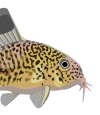
| Identification | Corydoras are identified by their twin rows of armour plates along the flanks and by having fewer than 10 dorsal fin rays. They are most commonly confused with the other genera in the sub-family, namely Brochis, Scleromystax and Aspidoras. Bright orange fin colouration and spotted body means that this species can only really be confused with C. sterbai, although the latter has a rounded snout where C. haraldschultzi is a long nosed species. Spots on the head can be used to differentiate them: C. haraldschultzi has dark spots on a light background, whilst C. sterbai have light spots on a dark background. Another species with orange fins is C. gossei, but this fish has no spots on the body at all, with spots only on the caudal fin. |
| Sexing | Females grow larger and are more full-bodied, this is best observed from above the fish. Males will typically have more pointed as opposed to more rounded fin tips as they mature. |
Habitat Information | |
| Distribution | South America: Central Brazil Amazon, Middle Amazon (Solimoes) |
| Temperature | 24.0-26.0°C or 75.2-78.8°F (Show others within this range) |
Husbandry Information | |
| Feeding | Will accept a wide range of commercial foods including tablets, granules and flakes. Live (or frozen) foods such as bloodworm, white worm, grindal worm, Daphnia and tubifex are readily accepted. |
| Furniture | Shade provided by overhanging rock work, arching bogwood, tall or floating plants are all that is required. Ideally substrate should be sand, but rounded gravel is an imperfect alternative. Do not keep over regular, not rounded gravel, this will damaged the fishes barbels when it tries to dig. |
| Breeding | Unreported. |
Further Information | |
| References | Senckenb. Biol.v. 43 (no. 2) - pp129 - Fig. 1; Pl. 11 (figs. 1a-c) |
| Registered Keepers | (1) Lornek8, (2) philtre, (3) Daragh, (4) Dave Rinaldo, (5) fulvioander, (6) AmLi (k: 6), (7) Julie, (8) gem400 (k: 4), (9) smegforbrains, (10) fantonac (p: 5), (11) kamas88 (k: 6), (12) jha61, (13) Kampfer, (14) dandyfang, (15) ocnluv13, (16) bunthid tumnontigoon (k: 6), (17) mummymonkey (k: 3), (18) corybreed, (19) jp11biod, (20) dave.h (k: 4), (21) Mark Roesner. Click on a username above to see all that persons registered catfish species. You can also view all "my cats" data for this species. |
| Breeding Reports | None. |
| More Resources |
-
Search Planet Catfish for more on Corydoras haraldschultzi
- BBcode (for use in linking to this page from forum posts) - Look up Corydoras haraldschultzi on AquaticRepublic.com
- Look up Corydoras haraldschultzi on Fishbase, I.T.I.S. or ispecies search. - URL (for use in linking to the species from anywhere on the web) |
| Hits | 11949 hits. |
| Last Update | 2010 Feb 23 15:43 (species record created: 2001 Apr 30 00:00) |
Registered users: Bing [Bot], Google [Bot], medaka, MSNbot Media, Zebra46
© 1996 - 2012 PlanetCatfish.com, part of the Aquatic Republic Network group of websites. All Rights Reserved. By accessing this site you agree to our Terms and Conditions of Use.