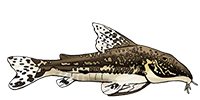
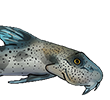


Cory = helmet, doras = skin. In this case it was incorrectly used to mean armour (cuirasse) instead of skin in allusion to the dual rows of plates that run along the flanks of this genus. Latin similis = like alluding to the similarity of the colouration of this species to Corydoras ourastigma.
Corydoras are identified by their twin rows of armour plates along the flanks and by having fewer than 10 dorsal fin rays. They are most commonly confused with the other genera in the sub-family, namely Brochis, Scleromystax and Aspidoras. C. similis is the round nosed ''version'' of the long snouted C. ourastigma. The smudged marking at the base of the caudal fin separates it from other head-spotted species that have a distinct spot marking instead.
Rio Jamari, tributary of the Rio Madeira, East Rondonia, Brazil Amazon, Middle Amazon (Solimoes), Madeira(click on these areas to find other species found there)
Flake, tablets. Live food such as whiteworm, bloodworm, brineshrimp and tubifex (sparingly). Frozen bloodworm is more easily supplied and seems to bring on growth in sub-adults very satisfactorily.
1. A ratio of 2:1 males to females has been successful at a pH of 7.2 and water at 76F which was reduced by approximately 5-6 degrees the day before spawning took place. It was back up to 76 when they began to spawn. 2. The spawning followed the typical ' T ' mating clinch, where the female nuzzles into the side of the male at a point just behind the pectoral fin. The male then clamps the female by her barbels (hence the need for good barbels, poor barbels means poor grip and possibly poor fertilization). Once the grip is complete both fish seemed to tremble for a few seconds, during this time the female deposited two 1.8mm eggs into a pouch made by clamping her ventral fins together. The female then broke away from the male and proceeded to find a suitable place to deposit her eggs. Altogether 28 moderately sticky eggs (out of a scale of 1 to 10 the these were 3) were laid all on the tank sides, all at various levels. 3. All the eggs were fertile and hatched in 4 days. 2 days after hatching the fry were free swimming and given pre-soaked powdered flake. This was followed by alternate small feedings of either brine shrimp or micro worm. 4. Fry Development is pictured above. The fry grew rapidly and at 7 days were 6.2 mm, at 14 days 9.0 mm, in 1 month 12 mm, after 2 months 16.4 mm, and after three months 21.0 mm. Adult colouration in 10 weeks. 5. After the spawning was complete the adult fish were removed, and the water treated with a few drops of methylene blue (1 drop per gal) to protect the eggs from fungal attack. Once the fry had hatched the water was changed at a rate of about 20% per day, for 5 days, removing the methylene blue concentration.
- CotM 1998 November - Show thumbnails of all species of Corydoras -
Search Planet Catfish for more on Corydorassimilis - BBcode (for use in linking to this page from forum posts)
- Email a friend a direct link to this species page - Look up Corydorassimilis on Fishbase, I.T.I.S. or ispecies search. - Print friendly layout of data - URL (for use in linking to the species from anywhere on the web)
Has this page been useful? Please click on the paypal button to make a secure & direct donation to our monthly hosting costs - it makes a real difference to us and we'll record the good deed for posterity. Help keep us free for everyone to enjoy!