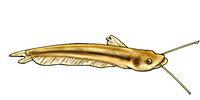


Cory = helmet, doras = skin. In this case it was incorrectly used to mean armour (cuirasse) instead of skin in allusion to the dual rows of plates that run along the flanks of this genus. Latin aeneus, brazen, of copper.
Corydoras are identified by their twin rows of armour plates along the flanks and by having fewer than 10 dorsal fin rays. They are most commonly confused with the other genera in the sub-family, namely Brochis, Scleromystax and Aspidoras. A very variable species. See catfish of the month link below. Occasionally confused with Brochis spp. but can be distinguished fairly easily by the number of rays and shape of dorsal fin - Corydoras have less than ten rays, Brochis have ten or more rays.
Tropical South America Amazon(click on these areas to find other species found there) La Plata, Paraná, Paraguay(click on these areas to find other species found there) La Plata, Paraná(click on these areas to find other species found there)
Shade provided by overhanging rock work, arching bogwood, tall or floating plants are all that is required. Ideally substrate should be sand, but rounded gravel will suffice.
Easily accomplished with captive raised stock. Some colour varieties are more challenging than others. Given the presence of a suitably egg-laden female and a mature male or two, spawning can be triggered by a large, cool water change. Try changing 30-40% of the aquarium water (at 21°C) and bring the temperature down to 16°C. Do this slowly over an hour or two.The fish should respond by spawning in the classic 'T' formation method. Here, using one of his pectoral fins, the male clamps the female to his side by her barbels and fertilizes a small batch of eggs held within the protective basket formed by her pelvic fins. The adhesive eggs are then placed on plants or aquarium walls and the process repeated. The eggs take 3-4 days to hatch. It is safe to leave well fed parents with the eggs, but some breeders prefer to remove the eggs, or indeed parents, to avoid any temptation of an easy snack. For the first few days of their life, pre-soaked powdered flake food should be fed to the fry. After the first 3 or 4 days, newly hatched brineshrimp can also be sparingly used to bring on the fishes growth. As the fish grow more and more foods can be offered in line with the size of the developing juveniles. Adult colouration is reached in around nine weeks.
- CotM 2001 December - Show thumbnails of all species of Corydoras -
Search Planet Catfish for more on Corydorasaeneus - BBcode (for use in linking to this page from forum posts)
- Email a friend a direct link to this species page - Look up Corydorasaeneus on Fishbase, I.T.I.S. or ispecies search. - Print friendly layout of data - URL (for use in linking to the species from anywhere on the web)
Has this page been useful? Please click on the paypal button to make a secure & direct donation to our monthly hosting costs - it makes a real difference to us and we'll record the good deed for posterity. Help keep us free for everyone to enjoy!