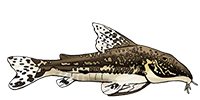





Cat-eLog Data Sheet | |
|---|---|
| Scientific Name | Synodontis dhonti Boulenger, 1917 |
| Common Name(s) | None |
| Type Locality | Kilewa Bay, Lake Tanganyika, Zaire. |
| Pronunciation | sin oh don tiss - don tee |
| Etymology | Synodontis: From the Greek syn, meaning together, and odontos, meaning tooth; in reference to the closely-spaced lower jaw teeth. |
Species Information | |
| Size | 360mm (14.2") SL. Find near, nearer or same sized spp. |
| Identification | All species in the genus Synodontis have a hardened head cap that has attached a process (humeral process) which is situated behind the gill opening and pointed towards the posterior. The dorsal fin and pectoral fins have a hardened first ray which is serrated. Caudal fin is always forked. There is one pair of maxillary barbels, sometimes having membranes and occasionally branched. The two pairs of mandibular barbels are often branched and can have nodes attached. The cone-shaped teeth in the upper jaw are short. S-shaped and movable in the lower jaw. These fish produce audible sounds when disturbed rubbing the base of the pectoral spine against the pectoral girdle. Coloration in Alcohol- Body lacking spots; uniformly brown, all barbels brown; dorsal and pectoral-fin spines brown, filaments dark. All rayed fins uniformly brownish with black patches at base of rayed fins. Large axillary pore present; up to 22 mandibular teeth; 8 pectoral fin rays; premaxillary toothpad uninterrupted; maxillary barbel with narrow basel membrane; secondary branches on medial mandibular barbel present; granular papillae present on skin of body. Humeral process narrow, elongated, granulous; possessing distinct ridge on ventral margin; dorsal margin concave; terminating in a blunted point. |
| General Remarks | An explanation is in order as to why there is some confusion with what has been called Synodontis dhonti in the past. Synodontis dhonti (Boulenger 1917) was described from a single specimen collected in 1912. Synodontis irsacae (Matthes, 1959) was placed in junior synonymy with S. dhonti by Matthes in 1962 with specimens of S. irsacae being thought to be juvenile individuals of S. dhonti. Wright & Page in 2006 put forth that none of these specimens have carried on any ontogenetic changes that would support the idea of S. irsacae being a juvenile form of S. dhonti. A major difference between S. dhonti and S. irsacae also being the absence of an axillary pore in S. irsacae. Mathes cited a specimen in 1962 as being intermediate between the two species and this fish turned out to actually be a specimen of S. tanganaicae. Synodontis dhonti is a very large brown Synodontis based on its description. The fish many have kept for years as S. dhonti have neither grown very large or very brown, which suggests they are not what was once thought. |
Habitat Information | |
| Distribution | Africa: Lake Tanganyika. African Waters |
Husbandry Information | |
| Breeding | Unreported. |
Further Information | |
| References | Ann. Mag. Nat. Hist. (Ser. 8)v. 20 (no. 119) - pp367. Wright, JJ and LM Page (2006) Taxonomic revision of Lake Taganyikan Synodontis (Siluriformes: Mochokidae). Florida Mus. Nat. Hist. Bull. 46(4):99-154. |
| Registered Keepers | (1) Julie, (2) glyde (k: 3), (3) toby. Click on a username above to see all that persons registered catfish species. You can also view all "my cats" data for this species. |
| Breeding Reports | None. |
| More Resources |
-
Search Planet Catfish for more on Synodontis dhonti
- BBcode (for use in linking to this page from forum posts) - Look up Synodontis dhonti on AquaticRepublic.com
- Look up Synodontis dhonti on Fishbase, I.T.I.S. or ispecies search. - URL (for use in linking to the species from anywhere on the web) |
| Hits | 7738 hits. |
| Last Update | 2010 Oct 08 06:31 (species record created: 2002 Apr 12 00:00) |
Registered users: Bing [Bot], Coryologist, Google [Bot], MSN [Bot]
© 1996 - 2012 PlanetCatfish.com, part of the Aquatic Republic Network group of websites. All Rights Reserved. By accessing this site you agree to our Terms and Conditions of Use.