


3
2
1
Home Please visit Swiss Tropicals proud sponsor of PlanetCatfish.com
  |  Home  | |  CotM  | |  Cat-eLog  | |  Shane's World  | |  Forum  | |  Books  | |  Cool  | |  Search  | |  Help!  |
Quick find:
Convert Length, Temperature or Volume

Jump to next sectionCat-eLog > Mochokidae > Synodontis

Jump to next section Cat-eLog Data Sheet
Scientific Name Synodontis multipunctata  Boulenger, 1898     
Common Name(s) Cuckoo Catfish
Type Locality Sumbu, Lake Tanganyika.
Synonym(s) Synodontis multipunctatus
Pronunciation sin oh don tiss - mull tee punk TATT uss
Etymology Synodontis: From the Greek syn, meaning together, and odontos, meaning tooth; in reference to the closely-spaced lower jaw teeth. multi meaning many and punctata meaning spotted.
Jump to next section Species Information
Size 220mm (8.7") SL. Find near, nearer or same sized spp.
Identification All species in the genus Synodontis have a hardened head cap that has attached a process (humeral process) which is situated behind the gill opening and pointed towards the posterior. The dorsal fin and pectoral fins have a hardened first ray which is serrated. Caudal fin is always forked. There is one pair of maxillary barbels, sometimes having membranes and occasionally branched. The two pairs of mandibular barbels are often branched and can have nodes attached. The cone-shaped teeth in the upper jaw are short. S-shaped and movable in the lower jaw. These fish produce audible sounds when disturbed rubbing the base of the pectoral spine against the pectoral girdle.

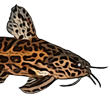
The base coloration is whitish grey, becoming a stronger brownish, often a very attractive golden bronze, on the head and upper body. The belly is whitish with or without spots. On the base color there are roundish dark spots of variable size, at most eye diameter and smaller on the head. In juvenile specimens spots are larger, irregular and sometimes confluent. Maxillary and mandibular barbels white. Iris yellowish to copper colored. Dorsal and pectoral-fin spines brown to black, filaments white. Pectoral spine with thin, light stripe along anterior margin. Dorsal and pectoral fins with black triangles at base, posterior margins white in color. Triangles in this species may be completely solid or composed of closely spaced dots. Black triangles at base of pelvic and anal fins absent or poorly developed. Single black spot may be present at the base of these fins. Adipose fin with white dorsal edge. Both lobes of caudal fin with dark bar from base to tip, posterior margin of fin white. Axillary pore present, mandibular teeth 13-29, 8 pectoral fin rays, eye 44.9-62 % of snout length, premaxillary toothpad uninterrupted, secondary branches on medial mandibular barbel absent, papillae on skin of body absent. Adipose fin short, poorly developed, margin convex. Humeral process narrow in juveniles becoming wider in adults, elongated, granulous, possessing distinct ridge on its ventral margin in young specimens, ridge becoming indistinct in adults, dorsal margin concave, terminating in a sharp point.
Sexing Males have a higher dorsal fin. Females are generally plumper and more rounded in profile. As with other Synodontis, in male fish it is possible to distinguish a 3-4 mm genital papilla near the anus.
General Remarks S. multipunctata and S. grandiops are most reliably separated by pectoral-fin ray counts with S. mutipunctata having 1 pectoral fin spine with 8 soft rays and S. grandiops having a count of 1, 7 . The soft pectoral-fin elements (i.e. the rays) are almost always branched (the only exception being the last one or two rays, which are sometimes unbranched) a ray is counted as one at its base before it branches out. Also keep in mind the larger adult size of S. multipunctata. It appears a southern and northern (at least) tribe exist, with the northern being the ''regular'' form and the southern being generally paler with more spacing between the spots.
Jump to next section Habitat Information
Distribution Common throughout Lake Tanganyika, Africa
African Waters Show it on a map , Western Rift Valley Lakes, Tanganyika Show it on a map  (hover or click on these areas to show maps or find other species found there)
pH 7.8 - 8.2
Temperature 25.0-26.0°C or 77-78.8°F (Show others within this range)
Other Parameters Clean water low in nitrates appears to be important to keeping the fish in good health and inducing it to spawn.
Jump to next section Husbandry Information
Feeding Feeds on snails, crustaceans and insect larvae in the wild. Not a fussy eater in the aquarium, but prefers meat based over vegetable based food. Generally considered to be a specialized predator of Neothauma tanganyicense(a snail)
Furniture Natural habitat is littoral to benthic zones over shell, sand and mud bottoms, to a maximum depth of 170m (Coulter1991a). In aquaria caves formed by piling up calciferous rocks and Vallisneria. Porous rock also has the advantage of providing the fry with interstices in which to hide.
Compatibility A schooling fish that prefers the company of its own kind. We recommend keeping at least three and ideally five or more S. multipunctata together. Prefers crepuscular lighting. Generally peaceful, but may eat very small tank mates. Can hold its own with most Rift Lake catfish and cichlids seen in the hobby.
Suggested Tankmates Often kept with Tanganyika, Malawi and Victoria cichlids, but dedicated siluriphiles may wish to consider keeping Tanganyikan Synodontis in all Synodontis tanks.
Breeding See Catfish of the Month article (link below).
Jump to next section Further Information
References Proc. Zool. Soc. Lond.1898 (pt 3) - pp497. Florida Mus. Nat. Hist. Bull. 46(4):99-154. Seegers, (2008) The Catfishes of Africa pg.450
Registered Keepers (1) synoguy, (2) mikey, (3) madattiver, (4) Richard B (k: 5), (5) Tulio, (6) Barbie, (7) Trident2004, (8) vriesea (k: 6), who also notes: "Great catfish for a community tank. Mine are very scurry about both day and night. More impressive in a school.", (9) Lornek8, (10) JJP2, (11) Ak Viking, (12) Dave Rinaldo, (13) amergim, (14) caudalis (k: 8), (15) arndogg (k: 5), who also notes: "F1 juveniles living in my tanganikyan tank. right now, I have no intention of breeding, but it is possible down the line.", (16) oldfish, (17) straitjacketstar (k: 5), (18) GreenSynoMan (k: 4), (19) synodont_fan (k: 3), who also notes: "Great color and very mild mannered. Mine don't socialize much, so perhaps I need a bigger group.", (20) drgold (k: 8), (21) Cicolid, (22) Bristle nose, (23) bluenewt, (24) V, (25) kvnbyl (k: 8), (26) alga (k: 4), (27) H-TRAIN, (28) amcmaster (k: 13), who also notes: "bred first cuckoo 27/12/08 caliptera host successfully bred 6 litters of fry but caliptera have now stopped breeding for last 6 months total fry sold ~50", (29) jollysue (k: 6), (30) Snowy (k: 26), (31) unblinded (k: 21), who also notes: "These are my favorite catfishes because of the way they interact with one another. I have them with about 60 Mbuna cichlids and it is hilarious to see the cichlids try to bully them and they just act like it's part of a game.", (32) L127 (k: 13), (33) joepleco, who also notes: "More attractive than its ugly sister Syn. Petricola. This one is more secretive than petricola as the latter seems to be more diurnal. Never the less both are cool.", (34) glyde (k: 4), (35) Rootbear (k: 6), who also notes: "Cats are in a heavily populated Mbuna tank. They are very active and there has been one Mbuna spawn so far with no cat fry.", (36) Zebadee (k: 4), (37) amazonfishman, (38) syno-kev (k: 2), who also notes: "got the golden eye varient of this one its about 3 inches and comes out now and again when its hungry, 5 inch males june 2008 i think these maybe a pair ", (39) synodontisjack (p: 4), (40) Didgeridoo (k: 5), who also notes: "Using Astatotilapia nubilus as hosts. Still waiting on cats to spawn. Nubilus spawn once or twice every week. I've observed the dominant male multi nudging the largest female multi in the abdomen. Dunno if this is courting behaviour or not!?", (41) tomr (p: 2, k: 4), (42) Dinyar, (43) Julie, (44) elvis&lola, (45) ray_c (p: 5), (46) LowCat, (47) oxdeleon, (48) Tasplec (k: 3), (49) fleahound (k: 2), (50) Moomoo, (51) smegforbrains, (52) Kampfer, (53) pmbooper (k: 2), who also notes: "moving one from 30 gal to 40 gal cichlid fry tank ", (54) dragonphish, (55) neelhound, (56) reneb, (57) Wraith (k: 4), (58) earth intruder (k: 2), (59) redstallion02 (k: 10), (60) vman (k: 2), (61) ariefputranto, (62) judeblackburn (k: 2), (63) oliv67 (k: 22), (64) Caracal (k: 4), (65) raymond, (66) Groovylad (k: 3), (67) johnerud, (68) drpleco (k: 10), (69) toby (k: 6), (70) SHEAG35 (k: 16), (71) abraxis77, (72) daniel4832, (73) exasperatus2002, (74) Viktor Jarikov, who also notes: "the smallest in the tank, 1 1/2 " but not shy, feeds well", (75) cory777 (k: 3), (76) Bartman (k: 5), (77) fleshgear, (78) WoonyFishMan (k: 2), (79) Cento (k: 3), (80) oli (k: 3), (81) Cory_lover (k: 5), (82) Miss Dib Dabs, (83) theviper06 (p: 2, k: 2), who also notes: "Leo", (84) chubbikins, (85) LeeRoy (k: 9), who also notes: "I have keep this group with a group of Aulonacara. I have had fry hatched in this tank, but not in last couple years.", (86) Sooperblooper, (87) rayfong, (88) FunkyFredFrog (p: 2, k: 3), (89) Tony, (90) zebra1 (k: 4), (91) aquaoahu, (92) Profiel310 (k: 3), (93) SHEAG (k: 8), (94) Buddiechrist, (95) arapaimag (k: 10), (96) slayer5590 (k: 2), (97) clydeboy, (98) catfishhunter (p: 2), (99) kiwiplymouth, (100) TheCichlidKid15, (101) bigamefish, (102) anthonyking, (103) james gilbertson (k: 3), who also notes: "3 stunning fish, one female is heavily pregnant, when the light is turned off on a night they go crazy and get on brilliant with all fish in the tank", (104) monsterfishkeeper, (105) richb (k: 6), who also notes: "I acquired my first multis in 1982 and still have an original female from that group. I have had her 30 years as of this year! I spawned them in the mid'80s through the early 1990s but haven't worked with them since.", (106) mrfishydude, (107) shooter50014 (k: 7), (108) tamara (k: 2).

Click on a username above to see all that persons registered catfish species. You can also view all "my cats" data for this species.

Add this species to your My Cats species list Add this species to your "my cats" page.
Breeding Reports (1) tomr (b: 12).
More Resources Article - CotM > 2002 > July
Article - Shane's World > Reproduction > Spawning Synodontis multipunctata & S. lucipinnis
Search Planet Catfish - Search Planet Catfish for more on Synodontis multipunctata
Link - BBcode (for use in linking to this page from forum posts)
Look up AquaticRepublic.com - Look up Synodontis multipunctata on AquaticRepublic.com
Look up Fishbase - Look up Synodontis multipunctata on Fishbase, I.T.I.S. or ispecies search.
Link - URL (for use in linking to the species from anywhere on the web)
Hits 61260 hits.
Last Update 2010 Jul 17 03:48 (species record created: 2001 Apr 21 00:00)

Who is online

Registered users: Bing [Bot], Dave Rinaldo, Google [Bot], PlecoCrazy


© 1996 - 2012 PlanetCatfish.com, part of the Aquatic Republic Network group of websites. All Rights Reserved. By accessing this site you agree to our Terms and Conditions of Use.