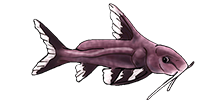



/siluriformes/plotosidae/cnidoglanis/macrocephalus/1.jpg "Cnidoglanis macrocephalus") Underwater
Underwater/siluriformes/plotosidae/cnidoglanis/macrocephalus/2.jpg "Cnidoglanis macrocephalus") Habitat: Found under ledges during the day
Habitat: Found under ledges during the day/siluriformes/plotosidae/cnidoglanis/macrocephalus/3.jpg "Cnidoglanis macrocephalus") Habitat: Found under ledges during the day
Habitat: Found under ledges during the day
 Cat-eLog Data Sheet Cat-eLog Data Sheet | |
|---|---|
| Scientific Name | Cnidoglanis macrocephalus (Valenciennes, 1840) |
| Common Names | Estuary Cobbler Estuarine Catfish, South Australian Catfish |
| Type Locality | Timor Island, southern Malay Archipelago [probably in error for Tasmania, Australia]. |
| Synonym(s) | Choeroplotosus decemfilis, Choeroplotosus limbatus, Cnidoglanis bostockii, Neoplotosus waterhousii, Ostophycephalus duriceps, Plotosus macrocephalus, Plotosus megastomus |
| Pronunciation | Nee doh glare nees - mak row see fah luss |
| Etymology | The generic name comes from the Greek knide, meaning nettle, and glanis, meaning catfish; in reference to the painful sting the fish is capable of inflicting. The specific epithet comes from the greek makros, meaning long, and cephale, meaning head; in reference to the longer head of this species. |
| Species Information | |
| Size | 910mm or 35.8" SL. Find near, nearer or same sized spp. |
| Identification | Distinguished by its mottled coloration, 222-234 total median fin rays and molariform teeth. |
| General Remarks | An inshore marine species which lives in shallow bays and sandy inlets near river mouths. Found most frequently over sand, rocks and weeds in clear to turbid waters. By day, cobbler are most often found in holes and on ledges in banks. They are opportunistic feeders, primarily feeding at night. Food consists of bivalve and univalve molluscs, crustaceans (small prawns and amphipods), polychaete worms, algae and organic debris. Juveniles eat more crustacea - often from among drifting macrophytic algae. Adults feed mainly on molluscs and polychaetes. Capable of inflicting painful stings with its spines. |
| Habitat Information | |
| Distribution | Indo-Pacific: endemic to Australia. Present along both eastern and western Australian coasts, from Kirra in southern Queensland to Jervis Bay in New South Wales, and from Kingston in South Australia to the Houtman Abrolhos in Western Australia. Distributional range extension to the Duck River in Tasmania needs verification. Australia waters (click on these areas to find other species found there) Login to view the map. |
| IUCN Red List Category | Data Deficient , range map and more is available on the IUCN species page. Last assessed 2009. |
| pH | 8.0 - 8.6 |
| Temperature | 20.0-25.0°C or 68-77°F (Show species within this range) |
| Other Parameters | Needs saltwater. |
| Husbandry Information | |
| Feeding | Juveniles may be fed a variety of foods, but adults may show a strong preference for molluscs. User data. |
| Furniture | A sand/gravel and coral/rock rubble bottom preferred. Make sure that there is enough rockwork for the fish to hide in during the day. |
| Compatibility | Fairly peaceful and compatible with most fish of equal size or larger in a marine setup, although adults appear to be solitary. |
| Breeding | The fish spawn in the austral spring (August-December). Males guard the eggs (a typical spawn consists of 500-3500 eggs) between their pelvic fins for an unknown period in the nest which the male have constructed among seagrass beds and rocks. The drift weeds found in inshore marine waters, protected inshore marine environments and estuaries act as nursery areas. Cobbler enter these areas during their first year of life and often remain there for long periods. |
| Breeding Reports | There is no breeding report. |
| Further Information | |
| Reference | Histoire naturelle des poissons v. 15, pp 428, Pl. 449. |
| Registered Keepers | There is no registered keeper. |
| Wishlists | Love this species? Click the heart to add it to your wish list. There is no wish to keep this species. |
| Spotters | Spotted this species somewhere? Click the binoculars! There is but a single record of this fish being seen, view it. |
| Forum BBCode | |
| Search for C. macrocephalus | |
 | Look up C. macrocephalus on AquaticRepublic.com |
 | Look up C. macrocephalus on Fishbase |
 | Look up C. macrocephalus on Encyclopedia of Life |
 | Look up C. macrocephalus on Global Biodiversity Information Facility |
| LFS label creator ARN ref:1.11.267.1037 | |
| Last Update | 2025 Jan 02 01:39 (species record created: 2003 Jun 09 00:00) |