


/siluriformes/doradidae/hemidoras/stenopeltis/1.jpg "Hemidoras stenopeltis")
Mouse Catfish - Hemidoras stenopeltis (Kner, 1855)
Article © Julian Dignall, uploaded November 01, 2000.
Down the list, usually far down the list, of occasional imports are the mouse or Hemidoras catfish. Most commonly imported of these (and that's not saying much) is this months featured fish.
All members of this family share a common feature in the row of hook like scutes running along the length of the fish, in all species of Hemidoras catfish this feature is quite subdued but still clearly visible.
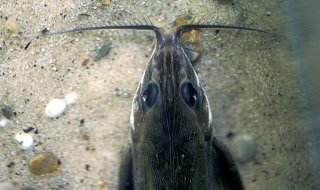 Mouse-like?
The common name mouse catfish is very appropriate in terms of its description of both behavior and appearance. This is a "timid beastie" with a sleek over all grey appearance usually spotted making nervous approaches at any food present. In addition, the fishes barbels are forward facing and feathered in such a way as to look much more like the whiskers of a mouse than a cat. They even twitch when food is near!
Their care isn't all that straightforward. The fish are quite difficult to acclimatize for Doradids especially if, at point of sale, they aren't in the best of condition. They are always wild caught and often appear for sale with pinched bellies, hollow faces and/or sunken eyes. Although they can be rescued from such a state it is certainly not without risk - buyer beware! Dutiful attention to water quality and frequent, regular feeding appear key to this fishes survival in the longer term. Once settled however they are easier to care for.
A note on identification. The black top mouse catfish is very similar to another mouse catfish, Nemadoras leporhinus, the main visual difference being the latter's clear dorsal fin with a black marking at its base. Aside from that N. leporhinus has longer leading fin rays. I mention this distinction because both these fish are often imported together with (and this is a rare find) the elongate mouse catfish, Leptodoras linnelli. Furthermore it can be distinguished from the similar Hassar catfish by its pointed humeral process. This bony plate behind the gills is more rounded in all species of Hassar cats.
Copyright information for the images used in this article can be found on the species' full Cat-eLog page.
 Cat-eLog Data Sheet Cat-eLog Data Sheet | |
|---|---|
| Scientific Name | Hemidoras stenopeltis (Kner, 1855) |
| Common Name | Mouse Catfish |
| Type Locality | Rio Negro, Amazon system, Brazil. |
| Synonym(s) | Doras stenopeltis |
| Etymology | Hemidoras: From the Greek hemi, meaning half, and doras, meaning skin (also a word commonly used in forming generic names for doradids); in reference to the similarity to Doras (another doradid genus). |
| Articles | |
| Species Information | |
| Size | 125mm or 4.9" SL. Find near, nearer or same sized spp. |
| Identification | The black top mouse catfish is very similar to another mouse catfish, Nemadoras leporhinus, the main visual difference being the latter's clear dorsal fin with a black marking at its base. Aside from that N. leporhinus has longer leading fin rays. Key characters are deep plates, pointed humeral process (vs. rounded in Leptodoras), short pointed snout, plates along back (also along ventral midline before anal fin) and tip of dorsal fin dipped in black. |
| Sexing | Adult males have what seems to be an enlarged dorsal spine. This is however a filament (as for instance can be seen in Synodontis decora). Females lack this feature. |
| Habitat Information | |
| Distribution | South America: Amazon River basin. Amazon (click on these areas to find other species found there) Login to view the map. |
| IUCN Red List Category | Least Concern , range map and more is available on the IUCN species page. Last assessed 2020. |
| pH | 6.0 - 7.6 |
| Temperature | 22.0-25.5°C or 71.6-77.9°F (Show species within this range) |
| Husbandry Information | |
| Feeding | Until acclimatized, the fish appears quite selective and like small foods. Crushed flake or sinking flake-based tablets best for smaller individuals although brineshrimp is taken by species around the 2'' mark. Larger, more settled fish are easier to feed and become very active during feeding. User data. |
| Furniture | Dense vegetation empowers this fish with a much needed sense of confidence in its surroundings. Caves or dark refuges appear less important. |
| Compatibility | Not aggressive and, as with all Doradids, sociable with its own species. Smaller fish appear to have an innate fear of larger fish and becomes very shy in their presence. |
| Suggested Tankmates | Shoaling tetras and Brochis are ideal. Dwarf cichlids and smaller labyrinth fish (Gouramis etc) are also suitably gentile. Larger, acclimatized fish will do well in a medium to large community set-up. At any size, best kept in shoals to ensure greater boldness and health. |
| Breeding Reports | There is no breeding report. |
| Further Information | |
| Reference | Sitzungsberichte der Kaiserlichen Akademie der Wissenschaften. Mathematisch-Naturwissenschaftliche Classe v. 17, pp 142 [53], Pl. 4 (fig. 7). |
| Registered Keepers | There is but a single registered keeper, view all "my cats" data. |
| Wishlists | Love this species? Click the heart to add it to your wish list. There is no wish to keep this species. |
| Spotters | Spotted this species somewhere? Click the binoculars! There are 3 records of this fish being seen, view them all. |
| Forum BBCode | |
| Search for H. stenopeltis | |
 | Look up H. stenopeltis on AquaticRepublic.com |
 | Look up H. stenopeltis on Fishbase |
 | Look up H. stenopeltis on Encyclopedia of Life |
 | Look up H. stenopeltis on Global Biodiversity Information Facility |
| LFS label creator ARN ref:1.12.141.1212 | |
| Last Update | 2025 Jan 02 01:38 (species record created: 2000 Nov 01 11:22) |
Back to Catfish of the Month index.