

/siluriformes/doradidae/acanthodoras/cataphractus/1.jpg "Acanthodoras cataphractus")
Chocolate Talking Catfish, Chocolate Raphael, Gemeiner Dornwels (Germany), Milky Catfish - Acanthodoras cataphractus (Linnaeus, 1758)
Article © Chris Ralph, uploaded May 08, 2007.
English catfish expert Chris Ralph introduces this months featured catfish.
Acanthodoras cataphractus is very popular amongst a number of catfish enthusiasts myself included. Unfortunately A. cataphractus is not commonly available to the hobbyist, but is sometimes imported amongst other representatives of the family Doradidae. When this fascinating catfish is available expect to pay £10-£12 for an adult fish. In their natural habitat these catfish are said to be abundant in the calm waters of swamps and mangroves. These catfish are most active at night preferring to take refuge during the day.
The body shape of this species is described as being depressed or flattened and elongated. The body is naked and is best described as being without scales. The body has a lateral row of bony plates which bear backwardly projecting spines referred to as "scutes". There are a number of small spiny projections above and below the lateral line situated behind the dorsal fin and extending towards the caudal fin. The head of A. cataphractus is large and flattened and is described as being granular with solidly united bones. The mouth is described as being terminal, with three pairs of barbels one pair of maxillary and two pairs of mandibular. The eyes are small or "piggy". The dorsal fin has 1 spine and 5 soft rays and the anal fin has 10-11 soft rays.
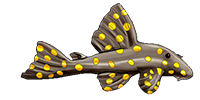
The species certainly is not as bad on the eye as some talking cats, its base colour of the body and head is chocolate brown (hence the common name of Chocolate Talking Catfish) overlaid with some almost creamy orange markings almost forming a stripe which leads from the head into the lateral line and body scutes; whilst giving some blotchy markings over the rest of the body which are mainly on the ventrolateral region of the body. The fin spines are coloured as are the fins themselves.
As with all the other doradids that I have had the pleasure to keep over the years, I've found this species to be omnivorous and readily accepts a mixed and varied diet which they search through the substrate for. I personally feed all of my doradids on sinking catfish pellets, good quality flake foods, granular foods, cultured whiteworm, earthworms, aquatic snails which they relish and frozen foods such as bloodworm to name but a few.
I would suggest a minimum size of 36" x 15" X 12" for a shoal of these fascinating catfish. The preferred substrate for keeping these catfish should be good quality aquarium sand such as BD Aquarium Sand, or very smooth rounded gravel in order to prevent their barbels from being damaged. The aquarium should provide some shelter in the form of rocks, bogwood and aquatic plants. As with all other species of fish, water quality and general husbandry is very important, and I would recommend that a minimum of 25% water is changed on a fortnightly basis.
Wherever possible I would recommend that the aquarist keep these catfish in small groups of four to six specimens, assuming that they are available in these numbers; failing this they are quite happy to shoal with other members of the family Doradidae.
Copyright information for the images used in this article can be found on the species' full Cat-eLog page.
 Cat-eLog Data Sheet Cat-eLog Data Sheet | |
|---|---|
| Scientific Name | Acanthodoras cataphractus (Linnaeus, 1758) |
| Common Names | Chocolate Talking Catfish Chocolate Raphael, Gemeiner Dornwels (Germany), Milky Catfish |
| Type Locality | America (in error). |
| Synonym(s) | Callichthys asper, Cataphractus americanus, Doras blochii, Silurus cataphractus |
| Pronunciation | ah KAN tho door ass - cat ah frak tuss |
| Etymology | Acanthodoras: From the Greek akantha, meaning thorn, and doras, meaning skin (also a word commonly used in forming generic names for doradids); in reference to the spines on the bony scutes along the lateral line. The species name, cataphracta/us, means armoured or mail-clad. |
| Articles | |
| Species Information | |
| Size | 115mm or 4.5" SL. Find near, nearer or same sized spp. |
| Identification | The only genus of doradid with a fully rounded caudal fin. This fish is almost never a direct import can be be found by the aquarist with a discerning eye as bycatch among shipments of the more common Platydoras armatulus (often labelled P. costatus). In P. armatulus, the white markings along the flank connect above the eyes forming a 'V.' The markings of A. cataphractus do not connect on the head. In P. armatulus, the white flank stripe continues down the body and onto the caudal fin. The caudal fin of A. cataphractus lacks the white stripe and is mottled. |
| Sexing | Females typically larger with a more full, or 'plump', appearance. |
| General Remarks | The above specimen on the right was captured using a ten foot seine net on the banks of a small Amazon tributary on the Peruvian side of the Amazon across from Leticia Colombia. |
| Habitat Information | |
| Distribution | South America: Amazon River basin and coastal drainages of French Guiana, Guyana and Suriname. Amazon (click on these areas to find other species found there) Guyana Waters (click on these areas to find other species found there) Guyana Waters, Coastal Rivers of Guyanas, Suriname Coastal Rivers (click on these areas to find other species found there) Log in to view data on a map. |
| IUCN Red List Category | Least Concern, range map and more is available on the IUCN species page. Last assessed 2020. |
| pH | 6.4 - 7.4 |
| Temperature | 22.0-26.0°C or 71.6-78.8°F (Show species within this range) |
| Other Parameters | There are reports of this species from river mouth areas, but it is unlikely these are exported, those that do find their way into aquaria prefers softer water. |
| Husbandry Information | |
| Feeding | An opportunistic feeder that eats live, frozen and dry aquarium foods. It usually only comes out to feed after lights out. User data. |
| Furniture | A very shy retiring fish that, once released in the aquarium, is rarely seen again. Provide plenty of caves and other hiding places. In the wild, they typically hide among thickets of submerged plants. |
| Compatibility | A good choice for the medium to large community tank. The above specimen was caught alongside the doradids Platydoras armatulus, Agamyxis pectinifrons, and Amblydoras hancockii in submerged terrestrial vegetation. Also collected at the site were Brochis splendens and several Corydoras spp. |
| Suggested Tankmates | Anything but the smallest species. Good with other doradids. A peaceful community resident. |
| Breeding | Acanthodoras cataphractus are documented as having been spawned in aquaria. Both parents were observed digging a depression in the substrate into which the eggs were deposited. The eggs were guarded by both fish. The eggs hatched after 4-5 days although unfortunately the young did not survive beyond the fry stage of development. |
| Breeding Reports | There is no breeding report. |
| Further Information | |
| Reference | Systema Naturae, Ed. X v. 1, pp 307. |
| Registered Keepers | There are 31 registered keepers, view all "my cats" data. |
| Wishlists | Love this species? Click the heart to add it to your wish list. There are 4 wishes to keep this species, see who wants what. |
| Spotters | Spotted this species somewhere? Click the binoculars! There are 11 records of this fish being seen, view them all. |
| Forum BBCode | |
| Search for A. cataphractus | |
 | Look up A. cataphractus on AquaticRepublic.com |
 | Look up A. cataphractus on Fishbase |
 | Look up A. cataphractus on Encyclopedia of Life |
 | Look up A. cataphractus on Global Biodiversity Information Facility |
| LFS label creator ARN ref:1.12.38.626 | |
| Last Update | 2020 Sep 19 02:34 (species record created: 2007 May 08 18:20) |
Back to Catfish of the Month index.