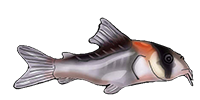



/siluriformes/bagridae/mystus/castaneus/1.jpg "Mystus castaneus")
Pearl Catfish - Mystus castaneus Ng, 2002
Article © Heok Hee Ng, uploaded June 01, 2004.
This month sees another first, the scientist who described a species of catfish then writes it up for a catfish of the month article! Something of a coup even though the ichthyologist in question is already a regular CotM contributor, Heok hee Ng. Here's what he has to say about this species.
It is perhaps reflective of the state of our knowledge of catfish diversity that one of the stalwarts in the aquarium industry, the pearl catfish, has remained misidentified until very recently. When it first appeared in the aquarium trade, the pearl catfish was identified as Mystus armatus, an Indian species, although it really comes from Southeast Asia. In any case, M. armatus is a species seldom imported in the aquarium trade and possesses a thin, dark band running along the length of the body that the pearl catfish lacks. Since then, several different names have been applied to it, most notably M. micracanthus and (more recently) M. nigriceps. Both these names refer to a species very similar-looking to the pearl catfish, but is more slender-bodied and has a more greenish-gray color. The identity of this catfish was finally established in 2002, when it was found to represent an undescribed species and described as M. castaneus.
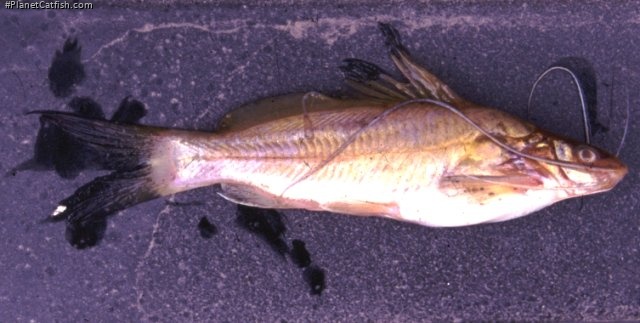
Wild caught albino specimen (fish was pink with pink eyes). The golden hue is probably related to diet.
One of the few species of sociable Mystus, the pearl catfish does well in small groups of 4–6 individuals. Their inquisitive, bold nature (they can be seen constantly probing around the tank with their long barbels) gives them an appeal that their color does not provide. Like many bagrids, they are not fussy feeders, and will lustily feed on a wide variety of foods. Because they do not grow to large sizes, pearl catfishes are generally safe with most fishes in a community tank (which is not to say they can be trusted with small fishes like neon tetras).
The pearl catfish is also one of the very few bagrid catfishes that have been bred in the aquarium (although the reports date back to the 1980s and no new reports have been forthcoming since; Garside, 1985), although almost all of the fishes encountered in the trade are still wild-caught.
Bagrid catfishes are do not generally behave well in community tanks, but the pearl catfish is one of the few exceptions. Although a rather drab fish by most standards, the pearl catfish makes up for its lack of color with its engaging personality. Add all of these and throw in its fairly wide tolerance of water conditions, and you can see why they remain popular to this day.
Reference:
Garside, F. 1985. The pearl catfish. Some notes on breeding. Aquarist and Pondkeeper 49(11):38–39.
Copyright information for the images used in this article can be found on the species' full Cat-eLog page.
 Cat-eLog Data Sheet Cat-eLog Data Sheet | |
|---|---|
| Scientific Name | Mystus castaneus Ng, 2002 |
| Common Name | Pearl Catfish |
| Type Locality | Serian market (from Sungai Sadong), Sarawak, malaysia, Borneo. |
| Pronunciation | miss tuss - kast AH nee uss |
| Etymology | The generic name is probably derived from the Latin mystax, meaning moustache, in reference to the long barbels. It was first used by Scopoli in 1777 making it a very old genus that has included many catfishes from throughout the world at one time or another. The specific epithet comes from the Latin word for chestnut brown, in reference to the color in life. |
| Articles | |
| Species Information | |
| Size | 144mm or 5.7" SL. Find near, nearer or same sized spp. |
| Identification | Fishes of the genus Mystus Scopoli are small to medium-sized bagrid catfishes occurring in South Asia. Roberts (1994) recognized Mystus to have an elongate cranial fontanel reaching up to the base of the occipital process, long maxillary barbel, very long adipose fin, 11–30 gill rakers on the first gill arch and 37–46 total vertebrae, about equally divided between abdominal and caudal regions. He included only eight species under the genus. Mo (1991) characterized the genus to have a thin needle-like first infraorbital, twisted and thickened metapterygoid loosely attached to the quadrate by means of ligament or a small extent of cartilage. Jayaram & Sanyal (2003) and Ferraris (2007) respectively listed 44 and 33 species of Mystus as valid. This species is often misidentified in the aquarium trade as M. armatus (an Indian species). Easily distinguished by its brown body, long barbels and dark triangular mark at the base of the caudal peduncle. |
| Sexing | Males have an elongate genital papilla in front of the anal fin. Females tend to be larger and fuller-bodied. |
| General Remarks | Note also this is probably the species in "F. Garside, 1985. The pearl catfish. Some notes on breeding." Aquarist and Pondkeeper 49(11):38-39. |
| Habitat Information | |
| Distribution | Asia: Indonesia, Malaysia and Borneo. Pacific, Malaysia Waters, Peninsular Malaysia Waters (click on these areas to find other species found there) Pacific, Greater Sunda Island Rivers (click on these areas to find other species found there) Log in to view data on a map. |
| IUCN Red List Category | Least Concern, range map and more is available on the IUCN species page. Last assessed 2019. |
| pH | 5.2 - 7.6 |
| Temperature | 24.0-29.0°C or 75.2-84.2°F (Show species within this range) |
| Other Parameters | Does best in soft, acidic (pH 5?6) water, although tolerant of harder (pH 7-7.5) water. |
| Husbandry Information | |
| Furniture | The tank should be furnished with ample driftwood and rocks. |
| Compatibility | Compatible with most fishes, although very small fishes will be eaten. Ideal tankmates include larger barbs and rasboras in an Asian biotope setup. This species is not overtly territorial, so more than one can be kept together. |
| Suggested Tankmates | Suitable for a community tank. Ideal tankmates are active mid-water fish such as barbs and rasboras. |
| Breeding | Prior to spawning the fish were kept in warm (23-24°C), very soft (3-4 GH), acidic (pH 6.8) water. A 25% change with water at 11°C reduced the ambient temperature to 21°C. This triggered a spawning response 7 hours later, the male displaying with fins outspread to the female. A few minutes of wriggling wit the fish side by side was followed by a locking of the pelvic fins and the female rolling over to an inverted position, releasing a cloud of several hundred eggs of ca. 1mm diameter. This was repeated for several times over two hours until several thousand eggs were released. The eggs drifted until sticking to plants or to the substrate, and began hatching after 24 hours The fry were free swimming three days after hatching. |
| Breeding Reports | There is no breeding report. |
| Further Information | |
| Reference | Raffles Bulletin of Zoology v. 50 (no. 1), pp 163, Fig. 2. |
| Registered Keepers | There are 9 registered keepers, view all "my cats" data. |
| Wishlists | Love this species? Click the heart to add it to your wish list. There is but a single wish to keep this species, see who wants what. |
| Spotters | Spotted this species somewhere? Click the binoculars! There are 6 records of this fish being seen, view them all. |
| Forum BBCode | |
| Search for M. castaneus | |
 | Look up M. castaneus on AquaticRepublic.com |
 | Look up M. castaneus on Fishbase |
 | Look up M. castaneus on Encyclopedia of Life |
 | Look up M. castaneus on Global Biodiversity Information Facility |
 | LFS label creator |
| Last Update | 2020 Sep 19 01:39 (species record created: 2004 Jun 01 11:22) |
Back to Catfish of the Month index.