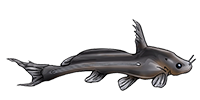



This is a subject that keeps cropping up time and again so I thought I would make this a sticky for all to check out before asking the question.
1. Body.
Generally females grow to a larger size than males.
2. Body.
Females when in good condition are plumper than males. When viewed from above the widest point of a females body is at a point level with or slightly to the rear of the ventral fin spines. In males the widest point is level with or slightly behind the pectoral fin spines.
3. Fins.
The ventral fins of the males tends to be more elongate and pointed, where as in females they are fan shaped and rounded. This feature can vary from species to species and in some cases there will be no visible difference.
There are some species where the dorsal and pectoral fins are greatly extended in the males.
4. Colour.
Although colour is not a dimorphic feature in all species there are a number of species where colour is the major difference, this is mainly within the so called "elegans" group and some members of the genus Scleromystax, (S. barbatus, S. kronei etc).
5. Secondary dimorphism
There are a small number of species that have a permanent secondary dimorphic feature, this is in the form of cheek odontodes (bristles). These species are, S. barbatus, S. kronei, C112, C113, C. geoffroy & C. macropterus.
Males of the so called curved or saddle snouted species also display seasonal secondary dimorphism in the form of extended growths of odontodes on the pectoral fin spines, although these are evident in both sexes to a greater or lesser degree, it is during the breeding season that the males become extended and bushy.
Ian
Sexing Corydoras
-
Coryman

- Expert
- Posts: 2119
- Joined: 30 Dec 2002, 19:06
- My articles: 12
- My catfish: 5
- My cats species list: 83 (i:0, k:0)
- My BLogs: 1 (i:0, p:46)
- Spotted: 194
- Location 1: Kidderminster UK
- Location 2: Kidderminster, UK
- Interests: Cory's, Loricariids, photography and more Cory's
- Contact:


-
Jools

- Expert
- Posts: 16273
- Joined: 30 Dec 2002, 15:25
- My articles: 198
- My images: 941
- My catfish: 237
- My cats species list: 87 (i:235, k:1)
- My BLogs: 7 (i:10, p:167)
- My Wishlist: 23
- Spotted: 450
- Location 1: Middle Earth,
- Location 2: Scotland
- Interests: All things aquatic, Sci-Fi, photography and travel. Oh, and beer.
- Contact:
Re: Sexing Corydoras
Owner, AquaticRepublic.com, PlanetCatfish.com & ZebraPleco.com. Please consider donating towards this site's running costs.
-
yannick62
- Posts: 29
- Joined: 23 Sep 2014, 22:35
- Location 1: Near Lille
- Location 2: France
- Interests: Keeping tropical fish
Ice hockey
Re: Sexing Corydoras
Thanks you for this very interressant article.
Yannick
Yannick
Yannick Mesnage
France (North near Lille)
France (North near Lille)
-
Thomas1209
- Posts: 41
- Joined: 28 Mar 2017, 16:38
- Location 1: Netherlands
- Location 2: Noord-brabant
Re: Sexing Corydoras
Maybe we can add some photo's as an example from above and the side, I think it will help a lot of people?
-
Jools
- Expert
- Posts: 16273
- Joined: 30 Dec 2002, 15:25
- My articles: 198
- My images: 941
- My catfish: 237
- My cats species list: 87 (i:235, k:1)
- My BLogs: 7 (i:10, p:167)
- My Wishlist: 23
- Spotted: 450
- Location 1: Middle Earth,
- Location 2: Scotland
- Interests: All things aquatic, Sci-Fi, photography and travel. Oh, and beer.
- Contact:
Re: Sexing Corydoras
Searching the Cat-eLog for the image caption pair yields lots of pictures, many of which are .Thomas1209 wrote: 25 Nov 2017, 21:08 Maybe we can add some photo's as an example from above and the side, I think it will help a lot of people?
https://www.planetcatfish.com/common/ca ... earch=pair
Jools
Owner, AquaticRepublic.com, PlanetCatfish.com & ZebraPleco.com. Please consider donating towards this site's running costs.
-
Woodh
- Posts: 165
- Joined: 14 Apr 2021, 12:28
- My cats species list: 6 (i:2, k:0)
- My aquaria list: 1 (i:1)
- Spotted: 7
- Location 1: Linkoping
- Location 2: Sweden
Re: Sexing Corydoras
Very informative, thanks! 